
Whooping Cough Vaccine London: Complete Travel Vaccination Guide
September 5, 2026
20 minute read
Planning International Travel? Whooping Cough Protection Matters for Adults Too

Whooping cough isn’t just a childhood disease. Adult cases are rising globally, particularly among travelers. The childhood vaccine most of us had? Protection fades after 5-10 years, leaving adults vulnerable.
Travelers face higher exposure risk. Crowded transport, shared accommodation, mixing with people from different regions, visiting areas with active outbreaks. Add travel fatigue and you’re more susceptible to infections you’d normally fight off.
This matters if you’re planning extended trips, visiting family with young children abroad, or working overseas. Whooping cough means weeks of severe coughing that disrupts everything. Getting vaccinated before travel is simpler than dealing with illness thousands of miles from home.
At Ealing Travel Clinic, we provide Repevax vaccination for London travelers. This single-dose vaccine protects against four serious diseases: diphtheria, tetanus, pertussis (whooping cough), and polio. £65, same-day appointments available, with immediate vaccination certificates for your travel records.
Book your Repevax vaccination – serving travelers across London including Ealing, Acton, Hammersmith, and surrounding areas.
Find Out If You Need Whooping Cough Vaccination in Under 2 Minutes
Answer four quick questions about your travel plans and we’ll give you a personalized recommendation based on your specific risk level. You’ll discover whether whooping cough vaccination is essential for your trip, which vaccine protects you (spoiler: it covers four diseases, not just one), and exactly what it costs with no hidden fees.
Most travelers complete this assessment in under 90 seconds. By the end, you’ll know exactly what you need to stay protected abroad – and you can book same-day vaccination if you’re in a rush.
Should you be vaccinated against whooping cough before you travel?
A short clinical assessment developed by our travel health team. Four questions, an evidence-based recommendation, and a clear next step. Takes under a minute.
What type of travel are you planning?
Why we ask: Pertussis transmission risk increases with trip duration and the nature of your activities. Humanitarian work, expatriate placements, and visits to family abroad carry meaningfully higher exposure risk than short holidays.
Will you be in close contact with infants or young children?
Why we ask: Infants under six months carry the highest risk of severe pertussis complications. Adults are the most common source of transmission to babies, and many adult cases are mild enough to go undiagnosed.
What type of accommodation will you be staying in?
Why we ask: Pertussis spreads through respiratory droplets in close indoor contact. Shared sleeping spaces, dormitories and crowded settings significantly increase exposure compared with private accommodation.
When did you last have a tetanus or pertussis booster?
Why we ask: Pertussis immunity from previous vaccination wanes over time. UK guidance suggests boosters every 10 years for travel, and sooner where exposure risk is elevated.
What Is Whooping Cough and Why Do Travelers Need Protection?
Whooping cough (pertussis) is a highly contagious bacterial respiratory infection caused by Bordetella pertussis. The name comes from the distinctive “whooping” sound people make when gasping for breath between severe coughing fits.
The Disease Pattern
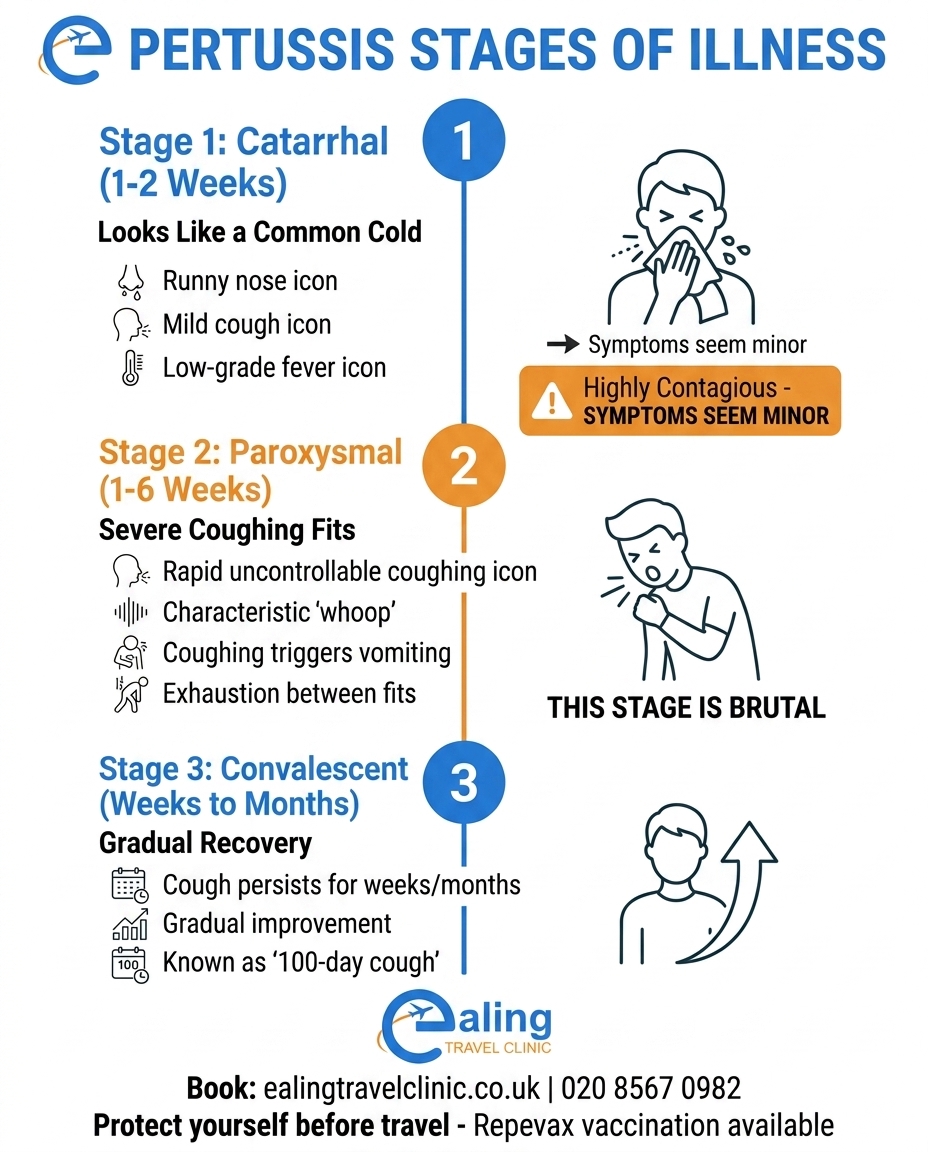
Whooping cough develops in three distinct stages, each with different challenges.
The first stage lasts 1-2 weeks and looks exactly like a common cold. Runny nose, mild cough, low-grade fever. Nothing remarkable. The problem? You’re highly contagious during this phase but symptoms seem so minor you probably don’t even stay home from work.
Stage two is where whooping cough earns its name. Severe coughing fits usually develop over 1-6 weeks. Rapid, uncontrollable coughing followed by that characteristic “whoop” sound when you finally manage to inhale. The coughing can be so violent it triggers vomiting. Between fits, you’re exhausted. This stage is brutal.
The third stage brings gradual recovery, though coughing can persist for weeks or even months afterward. The Chinese call pertussis “the 100-day cough” for good reason. Even after the worst passes, that cough lingers.
Why Adults Get Whooping Cough
Childhood vaccination doesn’t provide lifelong immunity. Protection wanes after 5-10 years, leaving adults vulnerable. You might have had the full childhood vaccine series and still catch whooping cough as an adult.
Adult whooping cough often presents differently than childhood cases. The characteristic “whoop” might be absent. Instead, you experience weeks of relentless coughing that disrupts sleep, strains ribs, and leaves you exhausted.
Global Whooping Cough Patterns
Pertussis occurs worldwide with some predictable patterns travelers should understand.
Whooping cough cases naturally peak every 3-5 years in most countries, regardless of how strong their vaccination programmes are. It’s a cyclical pattern that epidemiologists track but can’t fully prevent. After the unusually low activity during COVID-19 lockdowns, many countries experienced significant whooping cough resurgence in 2024-2025 as normal social mixing resumed.
Regional variations matter too. Countries with lower vaccination coverage see higher baseline rates year-round, not just during peak years. Outbreak activity varies by specific region and season within countries. And while infants face the highest risk of severe disease, travelers of any age can contract and transmit pertussis. Adults often don’t realize they have it until they’ve been coughing for weeks.
Whooping Cough Outbreaks Occur Globally
Recent whooping cough activity includes Ecuador (May 2025 outbreak), significant resurgence across Europe (2024-2025), and cyclical increases in Asia. Outbreak locations change frequently as new hotspots emerge. Travel health consultations include current disease activity updates for your specific destinations - more reliable than outdated online information.
Who Needs Whooping Cough Vaccination for Travel?
Adults Without Recent Tdap Booster
If your last tetanus booster was more than 10 years ago, you’re due for an update. The standard adult tetanus booster (Td) contains diphtheria and tetanus but NOT pertussis. Repevax gives you all four protections in one injection.
Consider this scenario: You cut yourself on rusty metal abroad. You rush to a clinic for tetanus protection. The clinic might not stock pertussis-containing vaccines. Getting Repevax before travel ensures you’re protected against all four diseases before departure.
Travelers to Whooping Cough Outbreak Areas
Whooping cough outbreaks occur regularly across all continents. Recent activity includes the May 2025 outbreak in Ecuador, significant resurgence across various European countries during 2024-2025, cyclical increases in parts of Asia, and case surges in regions recovering from pandemic-era restrictions.
Outbreak information changes frequently as new hotspots emerge and previous outbreaks fade. Travel health consultations include current disease activity updates for your specific destinations, which is far more useful than relying on outdated general information.
Travelers With Extended Infant/Child Contact Abroad
Planning to spend time with young nieces, nephews, or grandchildren overseas? Adults with whooping cough can transmit the disease to infants before showing obvious symptoms themselves.
The “cocooning” concept is straightforward: vaccinating adults who’ll have close contact with infants creates a protective barrier around the baby. While pregnancy vaccination protects newborns for the first weeks of life, family members and caregivers also need current pertussis immunity to complete that protective circle.
This matters for visiting family with newborns abroad, extended stays with young relatives, babysitting or providing childcare during travel, and multi-generational family trips where you’ll be spending significant time with infants or young children.
Long-Term Travelers and Expatriates
Living abroad for months or years increases your overall disease exposure compared to short holidays. Ensuring baseline immunity against common infections makes practical sense.
Healthcare access varies dramatically by location. You might not easily access booster vaccines in some countries, and local vaccination schedules often differ from UK standards. Having documentation of current vaccinations simplifies healthcare interactions when you do need medical attention abroad. These arepractical realities of long-term travel that baseline vaccination addresses before you leave.
Humanitarian Workers and Medical Volunteers
Working in healthcare settings, refugee camps, or areas with limited medical infrastructure brings increased exposure to vaccine-preventable diseases. Medical volunteers particularly need current pertussis protection if working in pediatric or maternity settings, refugee camps with crowded conditions, areas with disrupted vaccination programmes, or emergency response situations where disease transmission accelerates.
Whooping cough vaccination for visas, work and study abroad
Some universities, employers and visa routes ask for proof of an up-to-date whooping cough (pertussis) vaccination before you start, and this is where UK travellers are most often caught out. The standard UK tetanus booster, Revaxis, does not contain pertussis, so it is frequently rejected. Repevax does contain pertussis, which means a single dose usually satisfies the requirement and comes with a dated certificate for your records. We provide the vaccination and the documentation. Always confirm the exact wording of your requirement with the university, employer or visa route first, as these do change.

Study abroad: US universities and the Tdap requirement
US universities commonly ask incoming students for a documented dose of Tdap, a tetanus, diphtheria and pertussis booster, usually one given within the last ten years. This is the step that trips up UK students: a Revaxis dose is regularly refused because it contains no pertussis. Repevax and Boostrix both contain pertussis and are named on US university accepted-vaccine lists, so either will normally meet the requirement. We vaccinate you, provide a dated certificate showing the vaccine, batch number and diseases covered, and sign and stamp your university immunisation form to confirm the dose. Check your own university’s wording, as a few name particular brands or dates. Our guide to why US universities reject Revaxis and want Tdap covers the requirement in detail.
Work visas and jobs abroad, including Australia
Some overseas roles and employers, especially in healthcare, aged care, childcare and education, ask for a current whooping cough (pertussis) booster before you begin, and Australia is the one we are asked about most. A single Repevax dose provides pertussis cover alongside tetanus, diphtheria and polio, with a certificate for your paperwork. These requirements come from the employer, a regulator or the visa route rather than from us, and they can change, so confirm exactly what is needed before you book. We provide the vaccination and record, not immigration advice. Heading to Australia? See our guide to Repevax for an Australia work visa.
Which booster meets a Tdap or whooping cough requirement?
| Vaccine | Contains pertussis? | Usually accepted? | Notes |
|---|---|---|---|
| Revaxis | No (tetanus, diphtheria, polio) | No | The usual reason a UK dose is rejected |
| Repevax | Yes (plus tetanus, diphtheria, polio) | Yes | Single dose; the booster we provide, £65 |
| Boostrix / Boostrix-IPV | Yes | Yes | Also the booster used in pregnancy |
If you are not sure which your requirement asks for, bring the paperwork to your appointment and we will match it.
The Repevax Vaccine: What You’re Actually Getting
Four-in-One Protection
Repevax is a combination vaccine protecting against four bacterial diseases.
Diphtheria causes throat swelling that can block airways and produces toxins damaging the heart and nerves. It’s rare in the UK but still occurs in countries with lower vaccination coverage. Tetanus bacteria enter through wounds and produce toxins causing painful muscle spasms, including the distinctive “lockjaw.” Found in soil worldwide, tetanus has no person-to-person transmission, which means you can’t rely on herd immunity to protect you.
One Vaccine, Four Disease Protections - £65
Repevax protects against Diphtheria, Tetanus, Pertussis (Whooping Cough), AND Polio in a single injection. At £65 for all four, you're getting comprehensive protection at excellent value. Single dose required, same-day appointments available at Ealing Travel Clinic.
Pertussis is whooping cough itself – the highly contagious respiratory infection with prolonged, severe coughing that we’ve been discussing throughout this guide. And while polio is nearly eradicated globally, the virus still circulates in Afghanistan and Pakistan, meaning travelers to these regions need current polio protection.
All four protections in one injection, which is considerably more convenient than four separate vaccines.
Single Dose, Multiple Benefits
Unlike some travel vaccines requiring multiple doses weeks apart, Repevax is a single injection. If you’ve had childhood tetanus/diphtheria/polio vaccination, one Repevax dose provides:
- Immediate tetanus booster protection
- Renewed diphtheria immunity
- Pertussis protection you likely never had as an adult
- Updated polio protection
Protection begins within days for tetanus, diphtheria, and polio (if you’ve been vaccinated before). Pertussis antibodies develop over 2-4 weeks.
How Long Does Protection Last?
Tetanus and diphtheria protection lasts a minimum of 10 years, often longer. Pertussis immunity wanes more quickly – protection is strong for the first 4-5 years, then gradually decreases. By 10 years, pertussis protection has significantly diminished, though some protection persists. Polio protection is long-lasting, though boosters are recommended if you’re traveling to the two remaining endemic countries.
This pattern explains why Repevax is recommended as a one-time adult dose, with subsequent 10-year boosters typically using Td (tetanus and diphtheria without pertussis) unless specific risk warrants repeated pertussis vaccination.
Timing Your Whooping Cough Vaccination for Travel
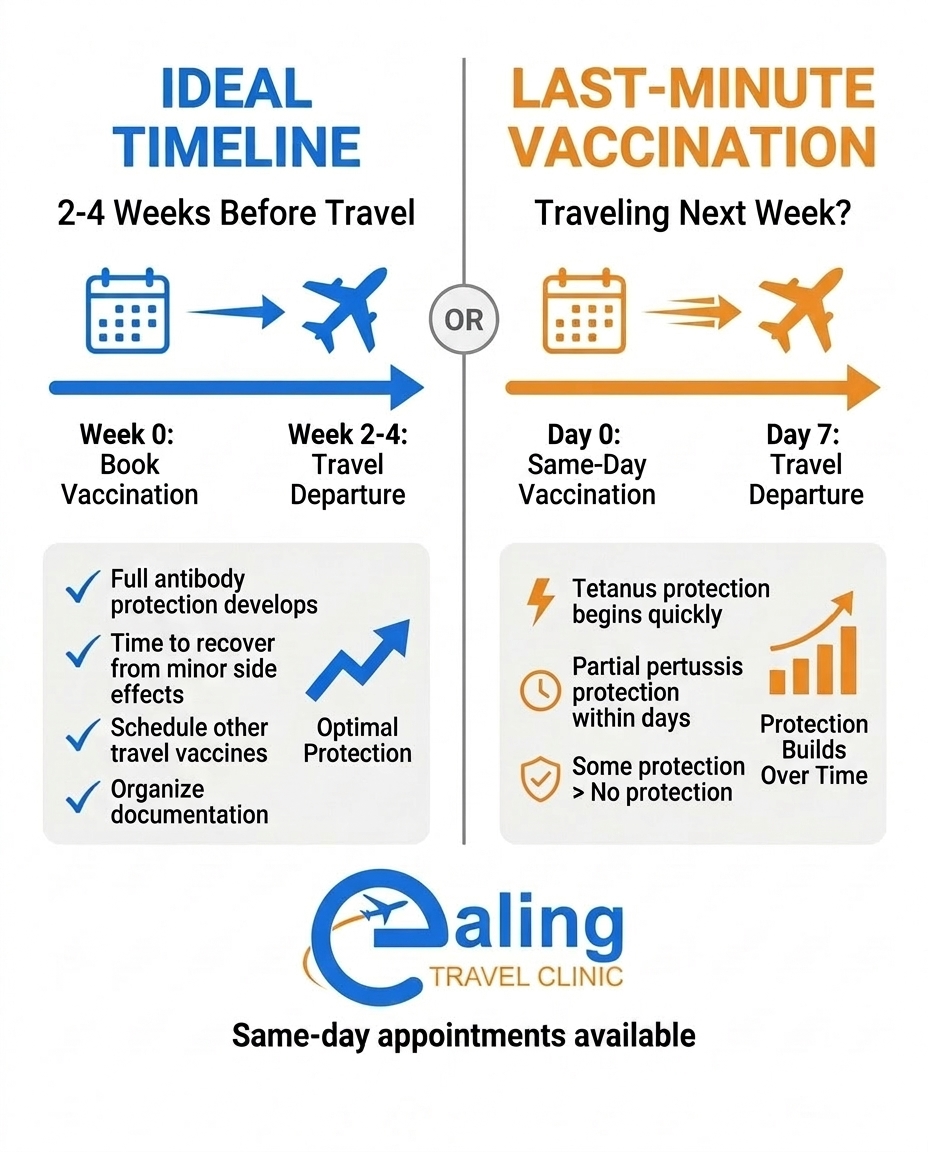
Ideal Timeline
Book your Repevax vaccination 2-4 weeks before travel for optimal protection development. This timeline allows full antibody response to develop, time to recover from any side effects (usually minimal), flexibility to schedule other travel vaccines without rushing, and gets documentation organized alongside your other travel preparations.
Last-Minute Vaccination
Traveling next week and just remembered your tetanus booster is overdue? Repevax still provides immediate benefit. Tetanus protection begins quickly, which matters for injury risk. Partial pertussis protection develops within days, with full protection following over subsequent weeks. And frankly, some protection beats no protection when you’re about to spend weeks in environments with higher disease exposure.
At Ealing Travel Clinic, we offer same-day appointments for urgent travel vaccination needs. Call us and we’ll usually see you the same day.
Book 2-4 Weeks Before Travel for Optimal Protection
Repevax vaccination works best when given 2-4 weeks before departure. This allows full antibody response to develop, time to recover from minor side effects, and flexibility to schedule other travel vaccines. Traveling next week? We offer same-day appointments - some protection beats no protection.
Combining With Other Travel Vaccines
Repevax can be given simultaneously with most travel vaccines, using different injection sites. Compatible same-day combinations include Hepatitis A, Typhoid, Hepatitis B, Rabies, Japanese Encephalitis, Meningitis ACWY, and Yellow Fever.
Your travel health consultation will identify all vaccines recommended for your destinations and create an efficient vaccination schedule.
What to Expect: The Vaccination Appointment
Pre-Vaccination Assessment
We’ll review your vaccination history, travel destinations and activities, current health status, any previous vaccine reactions, and medications or health conditions that might affect vaccination.
Bring any vaccination records you have. Don’t worry if records are incomplete, we can work with whatever information is available.
The Injection
Repevax is given as a single injection into the upper arm muscle. The injection takes seconds. Most people describe it as similar to any other vaccine – brief discomfort, then done.
Post-Vaccination Monitoring
We ask you to wait 10-15 minutes after vaccination. Serious allergic reactions are extremely rare. Our staff are trained in managing allergic reactions and emergency equipment is immediately available.
Vaccination Certificate
You’ll receive a vaccination certificate documenting the vaccine name (Repevax), date administered, batch number, diseases covered, and administrator details. Keep this with your travel documents. Some countries or situations like work placements or volunteer programs might request vaccination proof.
Side Effects: What’s Normal and What’s Not
Common Side Effects (Affecting 10-30% of People)
Injection site reactions: Pain, redness, swelling at injection site. Usually mild and resolves within 2-3 days. Move your arm normally to reduce stiffness.
Systemic reactions: Mild headache, fatigue, general body aches. Similar to mild flu symptoms. Typically resolve within 1-2 days.
Low-grade fever: Some people develop mild fever (under 38°C). This is your immune system responding appropriately.
Less Common Side Effects (Affecting 1-10% of People)
- Nausea or decreased appetite
- Dizziness
- More pronounced injection site swelling
- Mild rash
Managing Side Effects
For injection site pain, take paracetamol if needed and apply a cold compress to reduce swelling. Gentle arm movement prevents stiffness. For systemic symptoms like fatigue or headache, rest if you’re feeling tired, stay hydrated, and take paracetamol for relief. Avoid strenuous activity for 24 hours. For fever, use paracetamol, wear light clothing, and rest. Fever should resolve within 24 hours.
When to Seek Medical Advice
Contact us or seek medical attention if you experience high fever (over 39°C) persisting beyond 24 hours, severe injection site swelling extending down your arm, difficulty breathing or swallowing, severe headache or neck stiffness, widespread rash, or symptoms worsening rather than improving after 48 hours.
Serious reactions to Repevax are very rare. The risk of complications from tetanus, diphtheria, pertussis, or polio significantly outweighs the minimal risk from vaccination.
Whooping Cough Vaccine Pricing and Value

Transparent Pricing
Repevax vaccination at Ealing Travel Clinic:
- Cost: £65
- Includes: Pre-vaccination consultation, vaccine administration, post-vaccination monitoring, vaccination certificate
- No hidden fees: Price covers complete service
What £65 Actually Buys
One £65 Repevax injection covers four diseases at once: diphtheria, tetanus, pertussis and polio.
Beyond that, you’re getting expert consultation about your specific travel risks, proper vaccine storage and handling (vaccines lose effectiveness if stored incorrectly), qualified healthcare professional administration, immediate documentation for travel, and post-vaccination support if you have questions or concerns afterward.
Then there’s the peace of mind factor: protection against potentially serious diseases, reduced worry about preventable infections while traveling, avoiding disrupted travel due to illness, and lower risk of bringing infections home to vulnerable family members. These aren’t dramatic scenarios, but they’re real risks that vaccination addresses for £65.
Comparing to Disease Treatment Costs
Consider what happens if you contract one of these diseases while traveling. Whooping cough treatment abroad means medical consultations, potential hospital admission for severe cases, extended stay due to illness instead of enjoying your trip, lost travel experiences, and possibly medical evacuation if complications develop.
Tetanus treatment requires intensive care unit admission, antitoxin treatment, muscle relaxants to control spasms, potentially weeks of hospitalization, and possible long-term complications even with treatment.
Diphtheria treatment needs antitoxin if it’s even available where you are, antibiotics, potential ICU care, isolation precautions, and cardiac monitoring because the toxins damage your heart.
Special Situations and Considerations
Previous Whooping Cough Infection
Had whooping cough as a child or adult? You can still receive Repevax safely. Natural infection doesn’t provide reliable lifelong immunity, and vaccination boosts whatever immunity remains.
There’s no test to determine current pertussis immunity levels. Given that protection wanes whether from infection or vaccination, getting Repevax if you’re due for tetanus/diphtheria booster makes sense.
Pregnancy and Breastfeeding
Pregnant travelers: Whooping cough vaccination is routinely recommended during pregnancy (16-32 weeks) to protect newborns. However, this would typically use Boostrix (the pregnancy-specific formulation). Discuss your specific situation during consultation.
Breastfeeding mothers: Repevax is safe during breastfeeding. The vaccine doesn’t affect milk production or harm nursing infants.
Immunocompromised Travelers
People with weakened immune systems can safely receive Repevax since it’s an inactivated vaccine, not live. However, immune response might be reduced compared to healthy individuals.
Conditions requiring specialist advice include HIV/AIDS, active cancer treatment, immunosuppressive medications like those used after organ transplants, and severe combined immunodeficiency. We can coordinate with your specialist for appropriate vaccination timing and monitoring if you have any of these conditions.
Severe Allergies
Previous severe allergic reaction to any component of Repevax or to a previous tetanus, diphtheria, pertussis, or polio vaccine are contraindications. These situations require discussion about alternative protection strategies.
Severe allergies to other substances generally aren’t a contraindication to Repevax. Mention all allergies during your consultation for proper assessment.
Recent Illness
Currently unwell with fever: Postpone vaccination until recovered. Mild colds without fever don’t require postponement.
Recent tetanus booster: If you’ve had a tetanus-containing vaccine within the last year, discuss timing for Repevax to avoid unnecessary additional doses.
Beyond Vaccination: Reducing Whooping Cough Risk While Traveling
Understanding Transmission
Whooping cough spreads through respiratory droplets when infected people cough or sneeze. Close contact within 1-2 meters facilitates transmission. You’re most contagious during the early “common cold” stage before severe coughing develops, which is why the disease spreads so effectively.
High-risk situations while traveling include crowded transport like buses, trains, and planes, shared accommodation in hostels or guesthouses, group tours with sustained close contact, working in schools or orphanages or healthcare settings, and any situation involving close quarters with young children who might not be fully vaccinated.
Practical Prevention Strategies
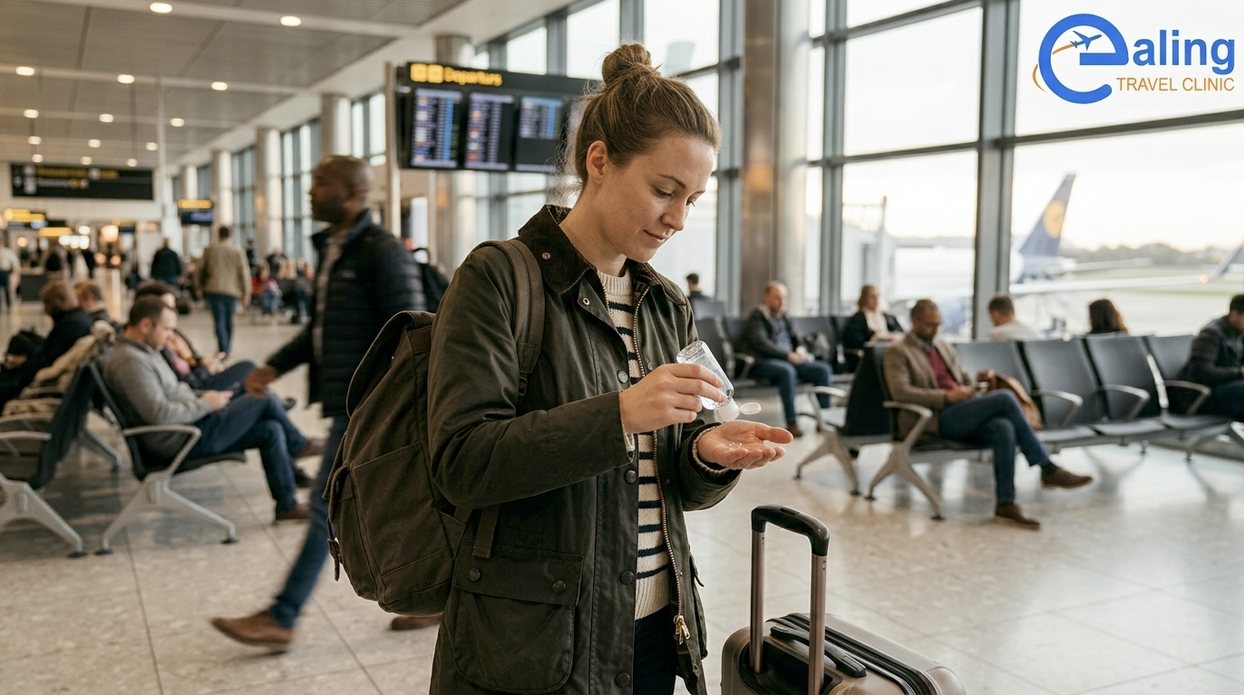
Practice good respiratory hygiene: cover coughs and sneeze with your elbow, not your hands. Dispose of tissues immediately and avoid touching your face after contact with potentially contaminated surfaces. Maintain distance from people with persistent coughing when possible.
Hand hygiene matters more than most people realize. Wash hands regularly with soap and water, use alcohol hand sanitizer when soap isn’t available, and be especially diligent after transport, before eating, and after spending time in public spaces.
Environmental awareness helps too. Choose well-ventilated accommodation when you have the option, spend time outdoors rather than in crowded indoor spaces, and reduce the time you spend in very crowded settings where respiratory diseases spread easily.
If you develop symptoms while traveling, seek medical evaluation for any persistent cough. Antibiotics can reduce your transmission period if started early enough. Isolate yourself from infants and young children, and inform people you’ve had close contact with so they can monitor for symptoms.
Whooping Cough and Other Travel Health Measures
Complementary Vaccinations
Travelers often need multiple vaccines depending on destinations. Commonly combined with Repevax:
- Hepatitis A (£45): Food and waterborne disease risk in most developing countries
- Typhoid (£30): Another food/water risk, single injection lasting 3 years
- Hepatitis B (£40 per dose, £120 for the course): Blood-borne disease, three-dose series
- Rabies (£90 per dose): Pre-exposure course for rural travel or animal contact; we confirm the schedule at your appointment
- Japanese Encephalitis (£110 per dose, £220 for the course): Two-dose series for rural Asia during transmission seasons
- Yellow Fever (£70): Required for entry to some countries, we’re a designated Yellow Fever centre
- Meningitis ACWY (£45): Required for Hajj pilgrimage, recommended for sub-Saharan Africa
Travel Health Beyond Vaccines
Malaria prevention requires antimalarial medications for endemic areas, with prevention strategy depending on the specific regions you’re visiting. Traveler’s diarrhea needs both prevention strategies and safe food and water guidance, plus standby antibiotic treatment for when prevention fails. Altitude illness prevention matters for high-altitude destinations like Kilimanjaro, Everest Base Camp, or the Peruvian Andes.
Travel insurance should be comprehensive and include medical evacuation coverage. Make sure your policy covers all planned activities, not just basic medical care. And put together a basic first aid kit appropriate for your destination and activities – what you need in rural Nepal differs from what you need in urban Singapore.
Book Your Whooping Cough Vaccination in London
Easy Booking Process
Online booking: Select your appointment time and book instantly. Choose a convenient date, complete your details, and you’re confirmed.
Phone booking: Call 020 8567 0982 during opening hours. Our team can answer questions and book your appointment.
Walk-in availability: Subject to capacity, but we prioritise appointment bookings for guaranteed service.
Location and Access
Ealing Travel Clinic 30 Northfield Avenue Ealing, London W13 9RL
Opening hours:
- Monday-Friday: 8:00am-6:30pm
- Saturday: 9:00am-5:30pm
- Sunday: Closed
What to Bring
Bring any vaccination records you have, a list of travel destinations and dates, your current medication list if you take regular medications, and your travel itinerary if you have it organized (this helps identify other vaccine needs beyond whooping cough).
Same-Day Service
Book online or call, come to your appointment, receive pre-vaccination consultation and health assessment, get your Repevax vaccination, wait for observation, receive your vaccination certificate, and continue with your travel preparations. The entire process typically takes under 30 minutes.
Comprehensive Travel Health Services
Whooping cough vaccination is one component of comprehensive travel health preparation. At Ealing Travel Clinic, we provide:
All travel vaccinations:
- Routine boosters (tetanus, diphtheria, pertussis, polio)
- Mandatory vaccines (Yellow Fever)
- Recommended travel vaccines (Hepatitis A/B, Typhoid, Rabies, Japanese Encephalitis, Meningitis, Cholera)
Malaria prevention:
- Risk assessment for your specific destinations
- Antimalarial medication prescriptions
- Prevention advice and bite avoidance strategies
Travel health consultations:
- Destination-specific health risks
- Food and water safety
- Insect-borne disease prevention
- Altitude illness prevention
- Traveler’s diarrhea management
- General travel health advice
Documentation:
- Vaccination certificates
- Yellow Fever certificates (official International Certificate of Vaccination)
- Medical letters for customs (if carrying medications)
Why Choose Ealing Travel Clinic
Specialist focus: We specialise in travel health, staying current on global disease patterns, outbreak information, and vaccination recommendations.
Convenient access: Central West London location with excellent transport links. Serving travelers from across London.
Flexible scheduling: Evening and Saturday appointments available for working travelers. Same-day appointments often available for urgent needs.
Comprehensive service: All travel health needs addressed in one appointment. Efficient vaccination schedules minimise the number of visits required.
Professional expertise: Experienced healthcare professionals specializing in travel medicine. Up-to-date knowledge of current global health risks.
Quality vaccines: Proper vaccine storage and cold chain management. Vaccines sourced from reputable manufacturers.
Get Protected Before You Travel
Whooping cough might not be the most exotic travel health concern, but it’s increasingly relevant for adult travelers. With rising global cases and waning childhood immunity, ensuring current pertussis protection makes sense alongside your other travel health preparations.
Repevax provides comprehensive protection against four vaccine-preventable diseases in one convenient injection. At £65, it’s straightforward value for travelers due for tetanus boosters or wanting updated pertussis immunity.
Ready to book your Repevax vaccination?
Book online now or call 020 8567 0982.
Whether you’re planning gap year adventures, visiting family abroad, working overseas, or just maintaining routine immunity for future travel, we make travel vaccination simple and professional.
Get your whooping cough vaccine sorted. Then enjoy your travels knowing you’re protected against preventable diseases.
Serving London travelers with comprehensive travel health services including vaccinations, malaria prevention, and destination-specific health advice.
Frequently Asked Questions
Table of Contents
- What type of travel are you planning?
- What Is Whooping Cough and Why Do Travelers Need Protection?
- Who Needs Whooping Cough Vaccination for Travel?
- Whooping cough vaccination for visas, work and study abroad
- The Repevax Vaccine: What You’re Actually Getting
- Timing Your Whooping Cough Vaccination for Travel
- What to Expect: The Vaccination Appointment
- Side Effects: What’s Normal and What’s Not
- Whooping Cough Vaccine Pricing and Value
- Special Situations and Considerations
- Beyond Vaccination: Reducing Whooping Cough Risk While Traveling
- Whooping Cough and Other Travel Health Measures
- Book Your Whooping Cough Vaccination in London
- Comprehensive Travel Health Services
- Get Protected Before You Travel
- Frequently Asked Questions

